
If you are a job applicant or an employee in the United States, you have certain legal rights when it comes to polygraph testing in your workplace. Polygraphs can be part of the hiring process for federal, state, and government jobs, as well as national security jobs. However, the Employee Polygraph Protection Act prohibits the majority of private employers from using them as part of their screening process.
The primary federal law governing their use is the Employee Polygraph Protection Act (EPPA), which was passed by Congress in 1988.
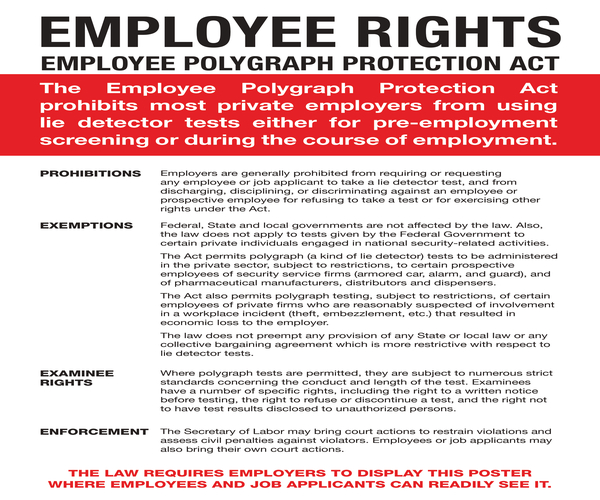
The Department of Labor enforces the EPPA, which aims to protect people from any potential abuses and intrusions related to polygraph testing. It establishes strict guidelines for employers and examiners who wish to administer these tests and provides a range of legal protections and remedies for employees who may be subjected to them.
Under the EPPA, most private employers are prohibited from requiring or requesting that job applicants or employees take a polygraph test, with a few exceptions. For example, employers in certain industries, such as armored car services, private security firms, or pharmaceutical manufacturers, may be allowed to require them as part of the job screening process. The EPPA also allows employers to administer polygraphs to employees who are reasonably suspected of involvement in certain types of workplace misconduct, such as theft or embezzlement.
However, even in cases where it’s allowed, there are strict guidelines and procedures that must be followed in the pre-test, testing, and post-test stages.
Examiners must also follow standardized procedures for conducting them and interpreting the results; they are prohibited from asking certain types of questions that could be considered invasive or irrelevant to the purposes of the examination.
In addition, it requires that examiners provide you with an opportunity to explain any physiological responses that may be related to medical or other factors rather than deception.
Legal Rights for Polygraph Examinees under the EPPA

Right to notice of examination
Under the EPPA, you have the right to receive notice of an examination in advance. Specifically, the employer must provide written notice, including the date, time, and location. Additionally, the notice must inform you of the nature and purpose of the examination as well as your full legal rights.
This notice must be provided at least 48 hours before the scheduled exam, and if you request it, they must provide a copy of the notice in a language that you understand. If they fail to provide it, any resulting test may be deemed inadmissible in a legal proceeding.
The notice requirement does not apply to certain examinations, such as those related to ongoing investigations of economic loss or injury or those required by federal, state, or local laws. In these cases, however, the employer must still provide some form of notice, even if it is not as extensive as the notice required under the EPPA.
Right to refuse examination
In accordance with the Employee Polygraph Protection Act (EPPA), you have the right to refuse to take a polygraph examination if your employer requires it. This means that if he asks you to take a polygraph, you can say no without fear of being fired or discriminated against.
If you refuse, he is prohibited from retaliating against you in any way. He cannot fire you, demote you, or reduce your pay or benefits.
As with the right to notice, there are some exceptions. For example, if you work in the security field, such as for a private security firm or a government agency, you may be required to take one as a condition of employment. In addition, if you are the subject of an ongoing investigation by law enforcement, you may be required to take one.
Right to confidentiality
Under the Employee Polygraph Protection Act (EPPA), you have the right to confidentiality with respect to the results of the test. Employers are not allowed to disclose them to anyone other than you or your representative. Additionally, they are required to maintain the results and any other records relating to the test in confidence for at least three years from the date it was conducted (or from the date the examination was requested if it wasn’t conducted):
- a statement of the incident.
- Any record of refusal to take a polygraph examination.
- Records of the number and duration of the examination, questions asked, and results.
The right to confidentiality helps protect you from any future negative consequences that may arise from a polygraph test. If an employer were to disclose the results to someone other than you, it could result in harm to your reputation, privacy, and future employment opportunities.
Nonetheless, keep in mind that there are certain exceptions to this requirement. For example, an employer may be obligated to disclose the results to a court or government agency if legally compelled to do so. Additionally, they may be allowed to disclose them if it is necessary to defend against a legal claim brought by you.
Right to have a representative present
In accordance with the EPPA, you have the right to have a representative present during the polygraph examination. They can be anyone you choose, such as a lawyer or a union representative, and they can provide you with advice and support throughout the process.
He is not allowed to answer questions on your behalf and must maintain confidentiality regarding the test results. They are also not permitted to interfere with the administration of the test in any way.
While you have the right to have a representative, you are not required to have one. You may choose to attend the examination alone.
Their presence can be particularly helpful if you have concerns about the execution of the test or if you are highly nervous or anxious about the process. They can help ensure that the examiner follows the proper procedures and that your rights are protected.
Right to an explanation of examination results
If you are subjected to an employment-related examination, you have the right to an explanation of the test’s results. This means that the examiner must provide a written report to you upon your request.
The written report should include information such as the questions asked, the examiner’s conclusions regarding your truthfulness, and any physiological responses observed during the examination. This document is required to be provided to you within a reasonable amount of time after the exam.
The EPPA does not require the examiner to disclose any trade secrets or confidential information related to the exam. However, you have the right to obtain a full explanation without compromising the private nature of the examiner’s methods or techniques.
Which questions are permitted to be asked?
There is a general scope of questions that could be asked. Depending on your test type, they could be about work-related concerns, injuries, criminal activities, drug usage, insurance history, credit history, providing false information, and other topics.
Under the EPPA, you have the right to interrupt the exam at any time and object to the questions. Specific questions about religious or political beliefs, religion, race, and sexual orientation are prohibited.
Exceptions to the EPPA
Exceptions to the EPPA are limited and narrow in scope. But include:
- National Security: Federal, state, and local government agencies may administer polygraph tests to employees involved in national security-related activities. However, such testing must comply with the standards and procedures established by the Employee Polygraph Protection Act.
- Investigations of Economic Loss: Employers may use polygraphs to investigate economic loss, such as theft or embezzlement, if the loss is substantial (generally defined as $5,000 or more). That said, they must have a reasonable suspicion that the employee was involved in the theft or loss and must follow strict procedures established by the EPPA.
- Controlled drug manufacturers or distributors: Employers engaged in the production, distribution, or dispensing of controlled substances may administer polygraph tests to employees involved.
- Certain Exempt Positions: Polygraph testing may be required for certain positions that are exempt from the EPPA, such as individuals working in security or with pharmaceuticals.
Even in these circumstances, the employer must still comply with all of the provisions of the EPPA. The testing must be conducted in accordance with strict procedures established by law, and any violation can result in serious penalties, including fines and potential legal action by the employee.
Summary of the prohibited practices under the EPPA

Practices related to polygraph testing that are prohibited, include:
- Firstly, employers are prohibited from requiring or suggesting that you take a polygraph as a condition of employment or continued employment. An employer cannot oblige you to take one before hiring you or fire you if you refuse to take it.
- Secondly, employers are not allowed to retaliate against employees who refuse to take one or who file a complaint regarding a violation of the EPPA. Including firing, demoting, or otherwise discriminating against those who exercise their legal rights under the EPPA.
- Thirdly, they are prohibited from using the results in a discriminatory manner. For example, they cannot use the results to act unfairly against employees on the basis of race, sex, age, religion, national origin, or disability.
- Lastly, they are not allowed to require you to waive your rights under the EPPA as a condition of employment or continued employment. This means that an employer cannot make you sign a document denying your right to protection under the EPPA.
These apply to most private employers, but there are some exemptions. Like those in federal, state, or local government agencies or to employers engaged in national security or defence-related activities.
Civil and criminal penalties for violating the EPPA
As an employee, it’s important for you to know that there are serious consequences for employers who violate the EPPA. As mentioned, it is enforced by the U.S. Department of Labor, which can investigate and take legal action.
Civil penalties
Civil repercussions for violating the EPPA can include fines of up to $10,000 per violation. In addition to fines, the employer may also be required to pay damages, including any lost wages, benefits, or other compensation. The EPPA also allows for the recovery of reasonable attorney’s fees and court costs.
Criminal Penalties
Criminal consequences can include fines of up to $20,000 and imprisonment for up to three years. These apply to both the employer and the person administering the test. It’s worth noting that criminal penalties are reserved for cases where the violation was willful or knowing, meaning the employer or administrator was aware they were breaking the law.
In addition to the penalties outlined in the EPPA, violating the law can also have reputational and business consequences. The mere mention of an EPPA violation can damage a company’s image and make it difficult to attract and retain employees.
Steps you can take if you believe your rights were violated

As an employee, you must know what steps to take if you have been subjected to illegal polygraph testing.
If you believe that your rights were violated, the first step is to inform the examiner of your concerns. If he is unwilling to address them, you can contact the U.S. Department of Labor’s Wage and Hour Division, which enforces the EPPA. Find and call the office nearest to you, and discuss with an investigator. While there is no official form to fill out regarding polygraph testing violations, if you decide to file a complaint, you may write a letter addressed to the WHD local office.
Include details of the occurrence, such as employer information, the date, and how the representative can contact you. Keep a copy of your letter and all communication with WHD representatives for your records.
You can also file a complaint with the Equal Employment Opportunity Commission (EEOC), which investigates allegations of employment discrimination. If you believe that you’ve been discriminated against because you asserted your rights under the EPPA, you may also have a claim under Title VII of the Civil Rights Act.
Take note that there are time limits for filing complaints, so it is important to act promptly. You should also keep records of any communication with the examiner or employer, as well as any documents related to the examination.
Challenges and Criticisms of the EPPA
One of the primary criticisms of the EPPA is that it does not go far enough in protecting employees’ rights. For example, some argue that it should prohibit employers from even suggesting that employees take polygraph tests, rather than just limiting when and how they can be used. They argue that the mere suggestion of a polygraph test can create a coercive and intimidating atmosphere and that the EPPA should do more to prevent this.
Another criticism is that it is difficult to enforce. Although the law provides for both civil and criminal penalties for violations, it can be challenging for employees to prove that their rights have been violated. In some cases, employers may simply ignore the EPPA and use polygraph testing anyway, relying on the fact that employees are unlikely to report them or that they will not be caught.
Lastly, some argue that it’s not practical or effective in preventing abuse. They say that employers can simply use other methods, such as psychological testing or background checks, and the EPPA does little to prevent this.
Government employees and other exemptions

The only employees excluded from the EPPA are those who work in government or other potentially sensitive public roles. This includes:
- Customs and Border Protection
- Federal, state, or local government officials
- Federal contractors engaged in national security intelligence or counterintelligence functions
In these positions, polygraph testing could be required, and one is eligible to be retaken after two years. While exempt from the Employee Polygraph Protection Act, employees in these sectors are protected by civil service rules.
The Civil Service Reform Act of 1978 prohibits discrimination against a federal employee based on race, color, religion, sex, national origin, age, handicapping conditions, marital status, or political affiliation, similar to the Employee Polygraph Protection Act.
Polygraph laws by state

While the Employee Polygraph Protection Act protects private citizens in all states, some states have specific laws. These include:
- Alaska: AS 23.10.037 prohibits an employer’s request or suggestion of a polygraph test. This does not apply to government officials or other civil service employees noted above.
- Nevada: Rev. Stat. Ann. 613.480 to 613.510 permits the use of polygraphs with manufacturers or distributors of controlled substances, providers or designers of security systems, and other security personnel.
- New Jersey: J. Stat. Ann. 2C:40A-1 allows polygraph testing when the individual has access to dangerous drugs or controlled substances.
- Pennsylvania: 18 Pa. Cons. Stat. Ann. 7321 allows polygraph testing when the individual has access to narcotics or dangerous drugs.
- Rhode Island: I. Gen. Laws 28-6.1-1 to 28-6.1-4 prohibit the request or suggestion of a polygraph test by an employer. This law does not apply to government officials or other civil service employees noted above.
- Vermont: Stat. Ann. tit. 21, § § 494 to 494e allows polygraph testing when the individual has access to controlled substances and those who sell precious gems and/or jewelry.
- Virginia: Code Ann. 40.1-51.4:3 prohibits questions specifically related to sexual activity.
- Washington: Rev. Code Ann. 49.44.120 allows polygraph testing when the individual has access to controlled substances.
- West Virginia: Va. Code 21-5-5a to 21-5-5d allows polygraph testing when the individual has access to controlled substances.
- Wisconsin: Stat. Ann. 111.37 permits the use of polygraph testing with manufacturers or distributors of controlled substances, providers or designers of security systems, and other security personnel.
The constitution on polygraphs
As polygraph testing has become increasingly common in the U.S., some citizens have raised concerns that it violates constitutional amendments. Nevertheless, no polygraph test has yet been ruled unconstitutional.
The fourth amendment secures:
“The right of the people to be secure in their persons, houses, papers, and effects against unreasonable searches and seizures shall not be violated, and no warrants shall issue but upon probable cause, supported by oath or affirmation, and particularly describing the place to be searched and the persons or things to be seized,”
Some have argued that polygraphs are a form of “search.” This amendment is particularly relevant to government employees who are required to take one. Polygraphing is not currently seen as a violation of this amendment, however.
The debate concerning the sixth amendment and polygraph testing was the focus of 44 M.J. 442 (reversed). The sixth amendment states that,
“In all criminal prosecutions, the accused shall enjoy the right to a speedy and public trial by an impartial jury of the state and district wherein the crime shall have been committed, which district shall have been previously ascertained by law, and to be informed of the nature and cause of the accusation; to be confronted with the witnesses against him; to have compulsory process for obtaining witnesses in his favor; and to have the assistance of counsel for his defense.”
This could mean polygraph testing should be permitted in court if used in defense, especially in accordance with Military Rule of Evidence 707. The United States v. Scheffer case, however, ruled that polygraphs being inadmissible in court is not unconstitutional due to their refuted accuracy.
Last words
While the EPPA has been successful in protecting employees from unethical polygraph testing, there are some difficulties and concerns. Some argue that it can be a valuable tool in certain circumstances, such as when investigating workplace theft or fraud. Others claim that the EPPA does not go far enough in protecting employee privacy.
Overall, it still plays a significant part in protecting employee rights and ensuring that polygraphs are used fairly and appropriately in any workplace. By understanding your rights under the act and asserting them when necessary, you can help ensure that you are fully protected.